
INTRODUCTION
The football analysis profession is so demanding and very technical, however, many that have ambitions to get into it think of it as a glamorous profession yet that is far from the truth. It is a thankless job, where you spend hours on work only to produce less than 15mins of digestible information whether through video or written reports. People do not see the long hours and in most cases do not care about the process it takes to produce what they want to see.
Despite the profession being thankless and exhausting, it is fulfilling and there still a growing interest in people getting into the profession. I get a request every week from someone asking me about how they can be a good football analyst and for many years I have given different answers that have been influenced by my state of mind in that moment. While in conversation with Paul a friend and colleague he said to me “anyone who wants to be a top analyst needs to watch 1000 football matches before they can get into working for a football club” Lamb, PJ. (2025) Conversation with Goolam Valodia and Tinashe-Shingai Mukandatsama, May 2025.
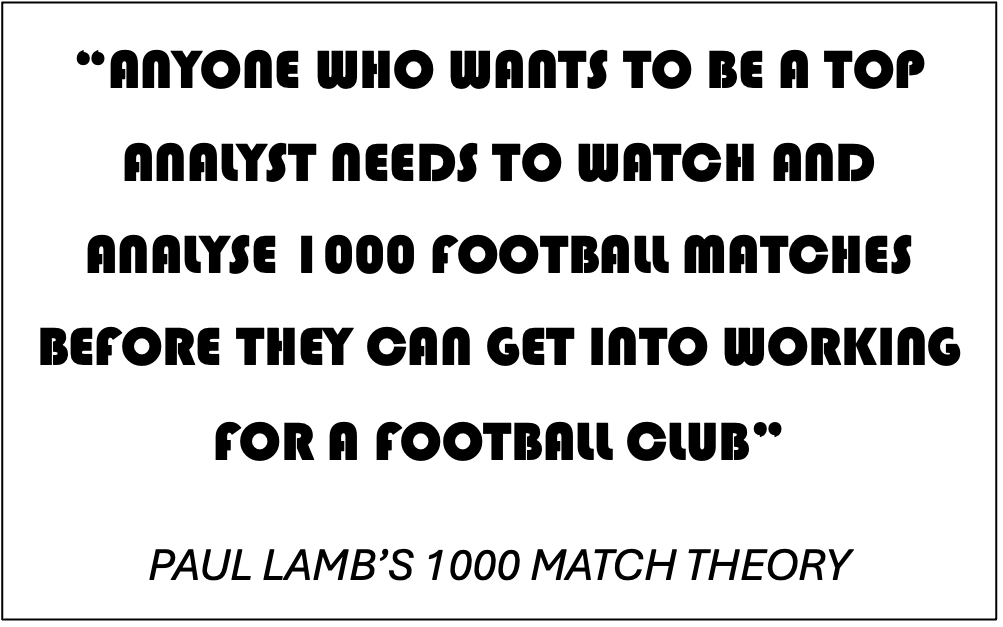
Paul speaks about this as a pre-requisite, because if one gets to watch and analyse 1000 matches then there is no doubt that they are able to navigate through the profession as an expert because from 1000 matches you are able to pick up many different things that would expand your knowledge of the game and create a strong information library and reference point, which will allow you to engage in high level football conversations with different football professionals.
Through my conversation with Paul, I was intrigued with his submission and as someone who likes to quantify and qualify theories, I found myself calculating how long it would take someone to watch 1000 matches and analyse all of them with detail. Having completed all my calculations and having taken time to ponder on Paul’s theory I thought of all my students, mentees and analysis prospects. What would be the ideal start for them to become analysts? Every profession has levels from beginner to intermediate all the way to expert level and the same apply for analysis the more you do the higher your level of expertise. So, for beginners I thought the rule of 100 fit perfectly for my mentorship programs and beginner classes.
THE RULE OF 100
100 DAYS | 100 MATCHES WATCHED | 100 VIDEO REPORTS | 100 WRITTEN REPORTS | 100% DEDICATION.

New analysts always think about working in big clubs before mastering the craft of analysis and when I was starting out I was lucky to have already gone through the process of watching matches and analysing because I wanted the team I was coaching to be better, little did I know that I would make a strong career out of analysis. Covid was the biggest catapult to my career it allowed me to learn and grow in the analysis field, because of the amount of time I had on my hands I would watch a minimum of 3 matches a day and write a report of every match I had watched in my notebook by the time we were cleared to resume to full time football activities I found myself fitting into the football environment and managing workloads easily because covid had prepared me well. The rule of 100 is therefore born from a personal experience that has worked for me, and prepared me to acquire this level of expertise in the field of performance analysis today 5 years on after the covid 19 pandemic. To date I have watched way over 1000 matches and therefore going by Paul’s theory I am at an expert level of football analysis.
HOW DOES IT WORK!
100 days is roughly 3 months and a few days (8-10) each football match is an average of 96minutes including added time therefore 100 matches x 96mins per match is about 9600minutes of football which translates to about 160hours of football. In this period one is exposed to over 100 000 football actions in different moments of the game and therefore your mind starts to develop its own theories and ideas which are stored as references in the brain and used when needed in different football conversations and contexts.
Now if everyone who wants to be a football coach or analyst starts their learning process before joining a club by watching 100matches, they are able to expand their knowledge and gain a strong knowledge base which will definitely make their integration into the profession much easier, before they are professionals, they are well trained students.
In academia training hours are a major determinant of expertise, how much hours in training someone spent is then converted into credits and classified into a qualification and the same should apply to football, especially in strong technical support roles like that of a performance analyst. Through this process, individuals do not enter the profession as people who are football lovers but instead, they get into the profession as capable football professionals contributing to the advancement of the game.
How does the rule of 100 create value and help one in becoming an expert let’s do a mock calculation of the benefits of the rule using low modest numbers:
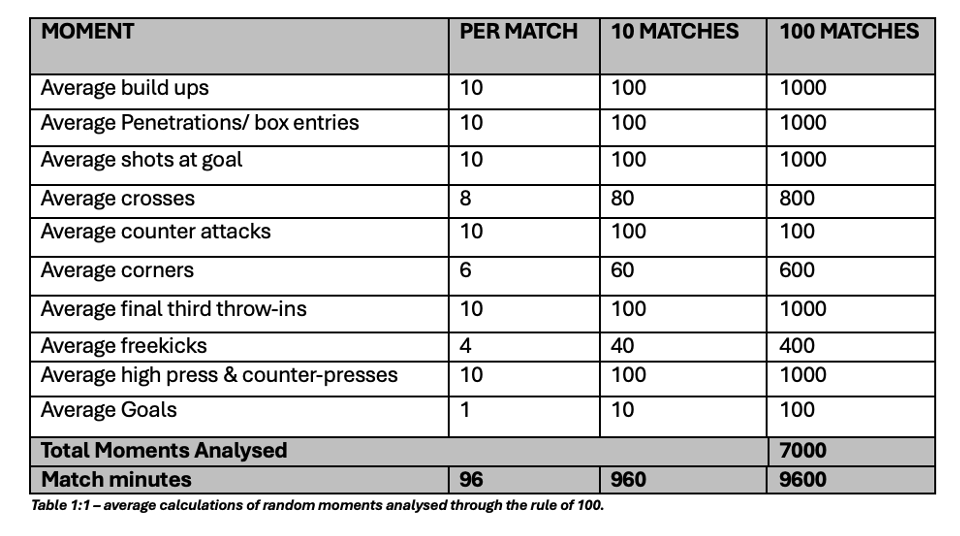
Through the rule of 100 it means that when one follows it religiously, they are able to complete 9600minutes of football which is about 160hrs. using the table above if they are to cut the moments in every match after 100 days, they will have a video library of a minimum of 7000 football clips that speak to different moments.
After this simple but effective process, it is a simple process because you are only watching 1 match per day, any aspiring analyst moves from being a prospect to a practising professional. Your level of reporting improves because you would have completed 100 written reports and 100 Video reports, your understanding of the game improves, and you are able to recognise different aspects of the game easily. Football is very technical and the influence of technology and general academia has become so instrumental that the profession itself has moved from being informal and about passion to being very technical and requiring academic application in practice.

This rule is not cast in stone; it is not a standard procedure for one to be an analyst it is developed based on experience and knowledge acquired in the industry. This rule is inspired by Paul’s 1000 match theory; it is inspired by K. Anders Ericsson’s study of violinists which gave birth to the 10 000hr rule popularised by Malcolm Gladwell. Like the theories that have inspired this article, it is not meant to be definitive instead it is a mechanism to aid aspiring coaches and analysts to start a process of improvement in order to set themselves apart from the rest in a highly competitive industry that is full of passionate individuals, “passion won’t carry you through, but the quality of your work and level of expertise will take you far”
Sources and references:
- Gladwell, M. (2008) Outliers: The story of success. New York: Back Bay Books.
- Lamb, PJ. (2025) Conversation with Tinashe-Shingai Mukandatsama and Goolam Valodia, May 2025.
2026: by Tinashe-Shingai Mukandatsama
https://medium.com/@tinashe.shingai/footballl-analysis-rule-of-100-b63a188aaeb2